SPONDON-THE DOOMSDAY SURVEY
The Domesday Survey of 1086, which was ordered to be carried out by William the Conqueror, shows that Spondon was a flourishing village and that before the Conquest it was owned by a prominent local man named Stori. When William conquered the country all the land came under his ownership, and he made large grants to his followers as a reward for their support. The Manor of Spondon was granted to a great Norman soldier named Henry de Ferrers who held is believed to have fought at the Battle of Hastings of 1066 and, in consequence, was rewarded with much land by King William for his conspicuous bravery and support at Hastings. Henry was granted 210 manors throughout England and Wales, but notably in Derbyshire and Leicestershire in 1070 he was awarded land in the Wapentake of Appletree, which covered a large part of south Derbyshire, including Spondon, granted to Henry on the promotion of Hugh d'Avranches to become Earl of Chester. At the centre of this was Tutbury Castle where he rebuilt and founded the priory in 1080. The castle and the de Ferrers manors have remained in the hands of the Earls and Dukes of Lancaster ever since.
The manor of Spondon included the whole of the village's territory. This was not always the case as sometimes there were two manors in a village, or, alternatively, several villages in a simple manor, e.g., Glossop. Spondon was only a small part of this person's lands, and he did not live here. He did not own Spondon in the sense that we use the word today. It remained in his possession only if he continued to serve and support the king. The real owner was the king, and he could take possession of the land if he were dissatisfied with his tenant. Indeed, this happened in the reign of Henry III when all the lands of the de Ferrers family were forfeited because they had rebelled against the king. Similarly, within the Manor, land was distributed amongst the men of the village. There were different 'grades' of peasants. There could be free tenants holding land in their own right, from which they took the profits, villeins with substantial holdings and bordars with smaller holdings in return for service to the lord and some who worked entirely for the Lord of the Manor and had no land of their own except a garden to their cottage. The land which the lord retained for himself was known as the demesne and this would be cultivated by the men of the village.
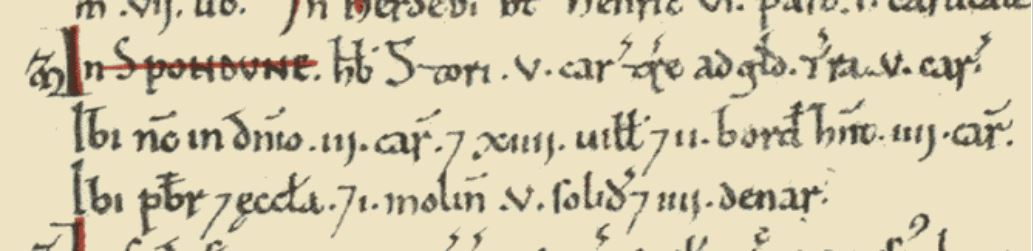
In Spondune Stori had v. carucates of land hidable. Land for v ploughs. There now in Demesne iii ploughs; and xiv villanes and ii borders having iv ploughs. There a priest, and a Church, and i mill worth v shillings and iv pence.
Households
Households: 14 villagers. 2 smallholders. 1 priest.
Land and resources
Ploughland: 5 ploughlands. 3 lord's plough teams. 4 men's plough teams.
Other resources
1 mill, value 5 shillings and 2 pence. 1 church.
Spondon - Lords of the Manor
In 1263, civil war broke out in England. Robert de Ferrers, 6th Earl of Derby, the son of William de Ferrers, 5th Earl of Derby, supported Simon de Montfort in the Baron’s Revolt against Henry III. The rebels were defeated in 1265 and their possessions confiscated. Henry III gave Tutbury Castle to his son Edmund whom he created Earl of Lancaster in 1267. In 1372 the castle formed part of a settlement granted by Edward III to his son, John of Gaunt, in exchange for the Earldom of Richmond.
By Escheat 3 Edward II (1309-1310) the Pipards held an estate at Spondon and Chaddesden, under the Earl of Lancaster. The manor of Spondon was granted, with that of Burrow-Ash, in 1563, to Thomas Stanhope in the reign of Henry IV (1399 - 1413), Spondon came into the possession of the Byrde Family possibly from estates held by the Knights of Burton Lazars. Also, in 1563 William Byrde sold the Manor to William Gilbert of Barrow who moved to Locko. In 1721, sold this manor, with Chaddesden and Locko, to Robert Feme. John Gilbert Cooper repurchased this estate in 1737, and in 1747 Richard Lowe, who died in 1785, bequeathed these manors to his relation, William Drury, who took the name of Lowe, and is the present proprietor.
The last male heir of this family was Richard Lowe, and he left his estates to a relation, William Drury, who assumed the name of William Drury-Lowe. He had a daughter Mary Anne who married Robert Holden of Darley Abbey, but their son abandoned the name of Holden and retained the family name, William Drury Lowe. The Manor has remained in the hands of this family down to the present day. The present head of the family is Capt. Patrick Drury Lowe of Locko Hall.
Medieval Farming
In the medieval period, most of the region was part of the 'Central Province' as defined by Roberts and Wrathmell Reference Roberts and Wrathmell 2002. This was a broad sweep of land extending from Dorset on the south coast to the north and east, encompassing the area east of the Pennines. Much of the landscape here is known as a 'champion landscape', with arable land organized into open fields divided into strips and cropped under a two- or three-year rotation. Once extensively covered with ridge-and-furrow, much of the medieval landscape has been destroyed by modern cultivation, though parts of the north-east Midlands retain well-preserved areas of ridge-and-furrow field systems, including areas of Lincolnshire.
The system of farming in Spondon was established before the Norman Conquest. The village was already well organised when the Normans conquered England in 1066. It is possible that, like most of the villages in this area, it was first settled by the Angles when they migrated into the area in the 5th century. The origin of the name Spondon is obscure. Spon in Old English meant chip or shaving of wood: it also meant shingle (stone used for tiles). Don in Old English meant hill. So Spondon could mean, a forest covered hill, or a hill where stone for tiles was found.